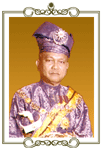
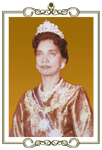
 1st Yang Dipertuan Agung ( H.M the King and Queen )31 AUGUST 1957 - 1 APRIL 1960)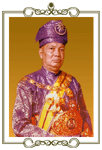
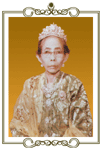 2nd H.M The King and Queen (14 APRIL 1960 – 1 SEPTEMBER 1960) The Sultan of Selangor
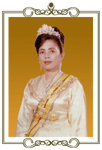

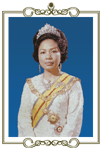 4th H.M The King and Queen (21 September 1965 – 20 September 1970) THE SULTAN OF TERENGGANU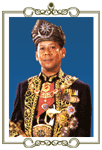
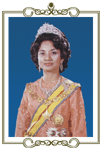 5th H.M The King and Queen (21 September 1970 – 20 September 1975) THE SULTAN OF KEDAH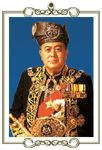
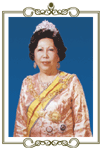

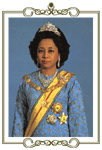
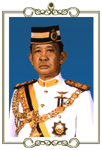
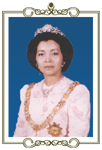
8th H.M The King and Queen (26 April 1984 – 25 April 1989) THE SULTAN OF JOHOR
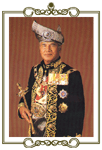
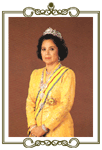

 10th H.M The King and Queen (26 April 1994 – 25 April 1999) THE YANG DI-PERTUAN BESAR OF NEGERI SEMBILAN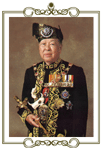
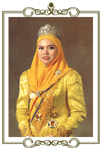
11th H.M The King and Queen ( 26 April 1999 – 21 November 2001) THE SULTAN OF SELANGOR
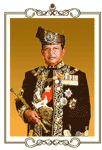

12nd H.M The King and Queen (13 December 2001 – 12 December 2006) THE RAJA OF PERLIS
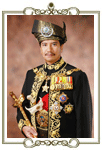
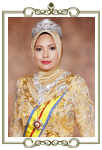
13th H.M The King and Queen (13 December 2006 - present ) THE SULTAN OF TERENGGANU
The Position Of The Yang di-Pertuan Agong
The Order of Precedence presently used is the twentieth Federal Order of Precedence. This order of precedence was gazetted and came into force on the 22nd January 1998 vide Government of Malaysia’s gazette Volume 42 No P.U. (B) 29 dated 22nd January 1998. It lists the 70 positions in the following order of precedence:
-Yang di-Pertuan Agong.
-Raja Permaisuri Agong.
-Rulers and Acting Rulers.
-Yang Dipertua Negeri.
-Former Raja Permaisuri Agong receiving Royal pension from the Federal Government.
-Prime Minister.
-Deputy Prime Minister. Courtesy – 7A. Heir Apparent (Tengku Mahkota/ Raja Muda).
-Members of the Darjah Utama Seri Mahkota Negara (D.M.N.).
-Members of the Seri Maharaja Mangku Negara (S.M.N.).
-Members of the Seri Setia Mahkota (S.S.M.) Courtesy — 10A. The Four Dato Undang of Negeri Sembilan and Tengku Besar Tampin, Negeri Sembilan.
-Chief Justice of the Federal Court.
-President of the Senate.
-Speaker of the House of Representatives.
-Former Prime Ministers.
-Former Deputy Prime Ministers.
-Members of the Cabinet.
-Secretary to the Cabinet Chief Secretary to the Government. Courtesy – 17A. Menteri Besar -and Chief Ministers.
-Attorney General.
-Chief of the Armed Forces Staff.
-Inspector-General of Police.
-Director-General of Public Services.
-Deputy Ministers.
-Deputy President of the Senate and Deputy Speaker of the House of Representatives.
-High Commissioners, Ambassadors, Minister Envoys, Acting High Commissioners and Charge de’ Affaires.
-President of the Court of Appeal.
-Chief Judge of the High Court in Malaya.
-Chief Judge of the High Court in Sabah and Sarawak.
-Opposition Leader in Parliament.
-Judges of the Federal Court.
-Judges of the Court of Appeal.
-Parliamentary Secretary.
-Former Chief Secretary to the Government.
-Staff I, II and III officers.
-Former Attorney Generals, Former Chief of the Armed Forces Staff and Former Chief of the Inspector-General of Police.
-Chairman of Commissions established under the Federal Constitution.
-Judges of the High Court.
-Chairman of the Public Services Tribunal.
-Judicial Commissioners.
-Auditor General.
-Governor of Bank Negara.
-Mayor of Kuala Lumpur.
-Chairman of the Government Official Function.
-Mufti of the Federal Territory of Kuala Lumpur.
-Keeper of the Rulers’ Seal.
-Grand Chamberlain.
-Members of the Panglima Mangku Negara (P.M.N.).
-Members of the Panglima Setia Mahkota (P.S.M.).
-Royal Professors.
-Members of the Panglima Jasa Negara. (P.J.N.)
-Members of the Panglima Setia DiRaja (P.S.D.) Courtesy - 50A. Deputy Menteri Besar/Deputy -Chief Ministers. Courtesy - 50B. Speaker of the State Legislative Assemblies.
-Members of the Senate.
-Members of the House of Representatives.
-Grade ‘A’ Officers and Military and Police officers of equivalent rank.
-Chief of General Staff.
-Chief of Naval Staff.
-Chief of Air Staff.
-Deputy Inspector-General of Police.
-Secretary-Generals of Ministries.
-Vice-Chancellors of Universities. Courtesy - 59A. Members of the State Executive Councils and State Ministers in Sabah/Sarawak.
-Grade ‘B’ officers and Military and Police officers of equivalent rank.
-Chairman of Federal Statutory Bodies and Heads of Federal Statutory Bodies equivalent to Grade ‘B’ and above. Courtesy - 61A. Recipients of National Fellowship awards.
-Local Representatives of the United Nations.
-Grade ‘C’ officers, Military and Police officers and Heads of Federal Statutory Bodies of equivalent rank. Courtesy—63A. Members of the State Legislative Assemblies.
-Members of the Johan Mangku Negara (J.M.N.).
-Members of the Johan Setia Mahkota (J.S.M.).
-Members of the Johan Setia DiRaja (J.S.D.).
-Grade 1 officers, Military and Police officers and Heads of Federal Statutory Bodies of equivalent rank.
-Political Secretaries.
-Grade II officers and Military and Police services officers of equivalent rank.
-Consul-General of countries not having diplomatic representation in Malaysia.
Other Important Duties Of The Yang di-Pertuan Agong
Supreme Commander of the Armed ForcesHis Majesty the Yang di-Pertuan Agong is the Supreme Commander Of the Armed Forces as provided for in Article 41 as follows:
"41. Supreme command of the armed forces.
The Yang di-Pertuan Agong shall be the Supreme Commander of the armed forces of the Federation."
Power of Pardon
The Yang di-Pertuan Agong is also seen as the fountain of mercy. He is vested with the power to grant pardons and reprieves in respect of offences triable by court-martial and all offences committed in the Federal Territories of Kuala Lumpur and Labuan. This is provided for in Article 42 of the Federal Constitution as follows:
"42. Power of Pardon, etc.
(1) The Yang di-Pertuan Agong has power to grant pardons, reprieves and respites in respect of all offences which have been tried by court-martial and all offences committed in the Federal Territories of Kuala Lumpur, Labuan and Putrajaya; and the Ruler or Governor of a State has power to grant pardons, reprieves and respites in respect of all other offences committed in his State."
(2) Subject to Clause (10), and without prejudice to any provision of federal law relating to remission of sentences for good conduct or special services, any power conferred by federal or State law to remit, suspend or commute sentences for any offence shall be exercisable by the Yang di-Pertuan Agong if the sentence was passed by a court-martial or by a civil court exercising jurisdiction in the Federal Territories of Kuala Lumpur, Labuan and Putrajaya and in any other case shall be exercisable by the Ruler or Governor of the State in which the offence was committed.
(3) Where an offence was committed wholly or partly outside the Federation or in more than one State or in circumstances which make it doubtful where it was committed, it shall be treated for the purposes of this Article as having been committed in the State in which it was tried. For the purpose of this Clause the Federal Territory of Kuala Lumpur, the Federal Territory of Labuan and the Federal Territory of Putrajaya, as the case may be, shall each be regarded as a State.
(4) The powers mentioned in this Article:
(a) are, so far as they are exercisable by the Yang di-Pertuan Agong, among functions with respect to which federal law may make provision under Clause (3) of Article 40;(b) shall, so far as they are exercisable by the Ruler or Governor of a State, be exercised on the advice of a Pardons Board constituted for that State in accordance with Clause (5).
(5) The Pardons Board constituted for each State shall consist of the Attorney General of the Federation, the Chief Minister of the State and not more than three other members, who shall be appointed by the Ruler or the Governor but the Attorney General may from time to time by instrument in writing delegate his functions as a member of the Board to any other person, and the Ruler or Governor may appoint any person to exercise temporarily the functions of any member of the Board appointed by him who is absent or unable to act.
(6) The members of a Pardons Board appointed by the Ruler or Governor shall be appointed for a term of three years and shall be eligible for reappointment, but may at any time resign from the Board.
(7) A member of the Legislative Assembly of a State or of the House of Representatives shall not be appointed by the Ruler or Governor to be a member of a Pardons Board or to exercise temporarily the functions of such a member.
(8) The Pardons Board shall meet in the presence of the Ruler or Governor and he shall preside over it.
(9) Before tendering their advice on any matter a Pardons Board shall consider any written opinion which the Attorney General may have delivered thereon.
(10) Notwithstanding anything in this Article, the power to grant pardons, reprieves and respites in respect of, or to remit, suspend or commute sentences imposed by any court established under any law regulating Islamic religious affairs in the State of Malacca, Penang, Sabah or Sarawak or the Federal Territories of Kuala Lumpur, Labuan and Putrajaya shall be exercisable by the Yang di-Pertuan Agong as Head of the religion of Islam in the State.
(11) For the purpose of this Article, there shall be constituted a single Pardons Board for the Federal Territories of Kuala Lumpur, Labuan and Putrajaya and the provisions of Clauses (5), (6), (7), (8) and (9) shall apply mutatis mutandis to the Pardons Board under this Clause except that reference to “Ruler or Yang di-Pertua Negeri” shall be construed as reference to the Yang di-Pertuan Agong and reference to “Chief Minister of the State” shall be construed as reference to the Minister responsible for the Federal Territories of Kuala Lumpur, Labuan and Putrajaya.
(12) Notwithstanding anything contained in this Constitution, where the powers mentioned in this Article:
(a) are exercisable by the Yang di-Pertua Negeri of a State and are to be exercised in respect of himself or his wife, son or daughter, such powers shall be exercised by the Yang di- Pertuan Agong acting on the advice of the Pardons Board constituted for that State under this Article and which shall be presided over by him;
(b) are to be exercised in respect of the Yang di-Pertuan Agong, the Ruler of a State, or his Consort, as the case may be, such powers shall be exercised by the Conference of Rulers and the following provisions shall apply:
(i) when attending any proceedings under this Clause, the Yang di-Pertuan Agong shall not be accompanied by the Prime Minister and the other Rulers shall not be accompanied by their Menteri-Menteri Besar;(ii) before arriving at its decision on any matter under this Clause, the Conference of Rulers shall consider any written opinion which the Attorney General may have delivered thereon;
(c) are to be exercised by the Yang di-Pertuan Agong or the Ruler of a State in respect of his son or daughter, as the case may be, such powers shall be exercised by the Ruler of a State nominated by the Conference of Rulers who shall act in accordance with the advice of the relevant Pardons Board constituted under this Article.
(13) For the purpose of paragraphs (b) and (c) of Clause (12), the Yang di-Pertuan Agong or the Ruler of the States concerned, as the case may be, and the Yang di-Pertua Negeri shall not be members of the Conference of Rulers.
The Special Position of the Malays and Natives of Sabah and Sarawak
One of the important duties of the Yang di-Pertuan Agong is to safeguard the special position of the Malays and natives of Sabah and Sarawak. This is clearly stated in Article 153 (1) of the Federal Constitution as follows:
"153. Reservation of quotas in respect of services, permits etc.,
for Malays and natives of any of the States of Sabah and Sarawak.(1) It shall be the responsibility of the Yang di-Pertuan Agong to safeguard the special position of the Malays and natives of any of the States of Sabah and Sarawak and the legitimate interests of other communities in accordance with the provisions of this Article.”
Symbol of Honour and Dignity
His Majesty the Yang di-Pertuan Agong is seen as the symbol of honour and dignity. He confers awards and honours on citizens and non-citizens, and honours of the highest distinction on foreign heads of states during the investiture ceremony held in conjunction with His Majesty’s birthday.
Diplomatic Functions
As the Head of State the Yang di-Pertuan Agong appoints diplomats to serve in foreign countries and grants audience to foreign diplomats who are to serve in Malaysia before undertaking their duties.
Apart from performing his day-to-day functions and duties His Majesty also graces various social gatherings and official ceremonies.


.jpg)
.jpg)


+-+Copy.JPG)